Hydropower – Powering Arunachal Pradesh’s Economic Future
- The Government of Arunachal Pradesh has declared 2025–2035 as the “Decade of Hydropower,” targeting nearly 19,165 MW of hydropower capacity across 33 upcoming projects, leveraging its estimated potential of over 50,000 MW.
- Major projects under construction include the Lower Subansiri Hydroelectric Project (2,000 MW), Dibang Multipurpose Project (2,880 MW), and the Etalin Hydroelectric Project (3,097 MW) with an approved cost exceeding ₹30,000 crore.
- The Cabinet Committee on Economic Affairs approved the Kamala Hydroelectric Project (1,720 MW) with an investment of over ₹26,000 crore, and the Union Cabinet approved the Kalai-II Hydroelectric Project (1,200 MW) with an investment of over ₹14,000 crore.
- Hydropower development will transform Arunachal Pradesh's economy, with the state receiving 12% free power, 1% for Local Area Development Funds (LADF), and up to 26% equity participation in joint venture projects.
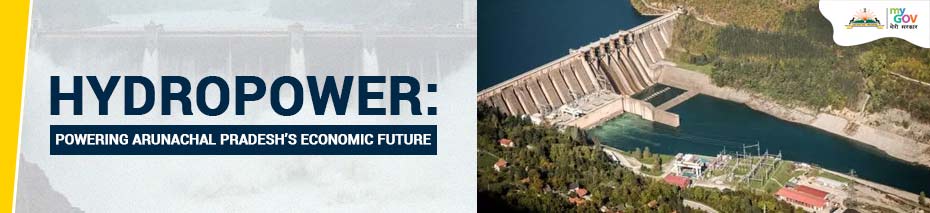
Arunachal Pradesh is rapidly emerging as the hydropower capital of India. With its snow-fed rivers and steep Himalayan gradients, the state holds an estimated hydropower potential of over 50,000 MW, accounting for a major share of India’s total hydropower potential. With the Government of Arunachal Pradesh declaring 2025–2035 as the “Decade of Hydropower,” the sector is expected to play a transformative role in the state’s economic future.
Gotv of Arunachal Pradesh has repeatedly emphasized that hydropower development is not only about electricity generation but also about infrastructure growth, employment, connectivity, and long-term economic self-reliance for Arunachal Pradesh. According to official estimates, the state is targeting nearly 19,165 MW of hydropower capacity across 33 upcoming projects.
Arunachal Pradesh’s Existing Hydropower Projects
At present, five hydropower projects have already been commissioned in the state:
- Kameng Hydroelectric Project – 600 MW
- Pare Hydroelectric Project – 110 MW
- Lower Panyor Hydroelectric Project – 405 MW
- Dikshi Hydroelectric Project – 24 MW
- Khangtang Hydroelectric Project – 7 MW
These projects have significantly strengthened the region’s power generation capacity while also contributing to local infrastructure and connectivity.
The Kameng Hydroelectric Project, commissioned in 2022, remains one of the most important operational hydropower projects in the region, supplying clean energy to the national grid.
Major Hydropower Projects Under Construction
Lower Subansiri Hydroelectric Project – 2,000 MW
Located along the Assam-Arunachal Pradesh boundary, the Lower Subansiri Hydroelectric Project is one of India’s largest hydropower projects. Developed by NHPC, the project consists of eight units of 250 MW each.
The project is being commissioned in phases, and once fully completed, it is expected to significantly enhance India’s renewable energy capacity.
Dibang Multipurpose Project – 2,880 MW
The Dibang Multipurpose Project in Dibang Valley is expected to become India’s largest hydropower project upon completion. Apart from power generation, the project is designed to support flood moderation in the Brahmaputra basin.
The project is expected to be completed around 2032 and will feature India’s tallest dam at 288 metres.
Etalin Hydroelectric Project – 3,097 MW
The proposed Etalin Hydroelectric Project in Dibang Valley is among the largest upcoming hydropower projects in the country. Developed by SJVN, the project has received key regulatory progress, including recommendations related to forest clearance.
With an approved cost exceeding ₹30,000 crore, the project is expected to generate large-scale employment and infrastructure development in the region.
Attunli Hydroelectric Project – 680 MW
Also located in Dibang Valley, the Attunli Hydroelectric Project is planned as a run-of-the-river scheme and is expected to generate around 2,728 million units annually.
Newly Approved Mega Hydropower Projects
Kamala Hydroelectric Project – 1,720 MW
In April 2026, the Cabinet Committee on Economic Affairs approved an investment of over ₹26,000 crore for the Kamala Hydroelectric Project across Kamle, Kra Daadi, and Kurung Kumey districts.
The project is expected to generate nearly 6,870 million units of electricity annually and will be developed jointly by NHPC and the Government of Arunachal Pradesh.
Kalai-II Hydroelectric Project – 1,200 MW
The Union Cabinet also approved the Kalai-II Hydroelectric Project in Anjaw district with an investment of over ₹14,000 crore. Developed by THDC India Ltd in partnership with the state government, the project is expected to generate around 4,853 million units annually.
The project is also expected to create employment opportunities and improve local infrastructure, including roads, healthcare, and connectivity in remote regions.
Other Upcoming Hydropower Projects in Arunachal Pradesh
Several additional projects are in various stages of planning, approval, and implementation, including:
- Heo Hydroelectric Project – 240 MW
- Tato-I Hydroelectric Project – 186 MW
- Tato-II Project
- Naying Hydroelectric Project
- Hirong Hydroelectric Project
- Demwe Lower Project
- Tawang-I and Tawang-II Projects
- Subansiri Upper Project
- Hutong Project
- Siang Upper Multipurpose Project – 11,000 MW (proposed)
Many of these projects are being implemented through partnerships between the Government of Arunachal Pradesh and central public-sector undertakings such as NHPC, NEEPCO, SJVN, and THDC India Ltd.
Economic Impact of Hydropower Development
Hydropower is expected to fundamentally transform Arunachal Pradesh’s economy in the coming decades.
Under existing agreements, the state receives:
- 12% free power
- 1% allocation for Local Area Development Funds (LADF)
- Up to 26% equity participation in several joint venture projects
These revenues are expected to strengthen the state’s financial resources and support investments in healthcare, education, roads, tourism, and welfare programs.
Hydropower projects are also expected to generate thousands of direct and indirect employment opportunities for local youth while accelerating development in remote districts. Infrastructure such as roads, bridges, schools, transmission networks, and healthcare facilities often develop alongside major projects, bringing long-term socioeconomic benefits to surrounding communities.
Supporting India’s Clean Energy Future
Hydropower plays a critical role in India’s renewable energy transition. Unlike thermal power, hydropower provides clean and flexible energy capable of supporting grid stability and balancing solar and wind energy generation.
For Arunachal Pradesh, this positions the state as a strategic contributor to India’s long-term clean energy goals while strengthening the development of the Northeast region.
Balancing Development and Sustainability
While hydropower presents enormous opportunities, environmental sustainability remains equally important. Arunachal Pradesh is one of India’s richest biodiversity hotspots, and concerns related to forests, river ecosystems, rehabilitation, and downstream impacts continue to shape discussions around hydropower development.
The government and project developers have emphasized the need for responsible and sustainable development through environmental assessments, community consultations, and rehabilitation measures.
Hydropower is steadily becoming one of the strongest pillars of Arunachal Pradesh’s future economy. From generating clean energy and creating employment to improving connectivity and strengthening state revenues, the sector has the potential to reshape the development trajectory of the state.
As Arunachal Pradesh moves forward with its “Decade of Hydropower,” the focus remains on ensuring that development is inclusive, sustainable, and beneficial to local communities. If implemented responsibly, hydropower could define a new era of economic growth and self-reliance for the state while contributing significantly to India’s clean energy future.