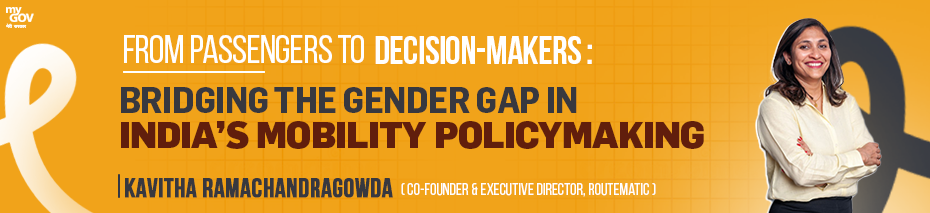
From Passengers to Decision-Makers: Bridging the Gender Gap in India’s Mobility Policymaking

Mobility is the backbone of India’s economy. It connects people to jobs, education, healthcare, and opportunities. Yet, let’s be honest—our transport systems, from public buses to metros to corporate mobility solutions, have largely been designed by men, for men. And that has left women out of the equation.
Despite making up nearly half of India’s population, women have little say in how our transport policies are shaped. There are hardly any women leading urban planning, transport policy, or corporate mobility. The result? A system that overlooks their safety, affordability concerns, and complex travel patterns. It’s not just about getting from point A to B—it’s about having the freedom to move without fear, financial strain, or constant inconvenience.
As India modernizes transport through projects like the Smart Cities Mission and Metro Rail expansions, we need to put women in decision-making roles. A system that works for women doesn’t just ensure safety; it unlocks economic and social mobility.
The Reality of Mobility for Women in India: An Everyday Safety Gamble
For women, commuting is often a battle against fear, inconvenience, and high costs. Women in India aren’t just worried about getting to work or college on time—they’re calculating whether it’s safe to travel at all. A 2024 Greenpeace report found that 75% of women in Delhi feel unsafe commuting by bus after dark, even though over 100 crore “pink tickets” have been issued for free travel. That’s a massive gap between policy and ground reality.
And let’s not even get started on the everyday harassment women face— unwanted attention on the streets, unsolicited and inappropriate remarks and messages, and strangers invading personal space in crowded buses. It’s routine. And in some cases, it gets far worse.
The First and Last Mile Nightmare
Many women rely on shared autos, cabs, or walking to bridge the gap between home and transit stops. But broken footpaths, poor lighting, and unreliable services turn a simple commute into a stressful ordeal. Furthermore, inadequate, unsafe, and unreliable transportation options disproportionately limit job opportunities for women, particularly those residing in areas with insufficient public transport facilities.
Affordability: When Mobility Costs More Than It Should
For lower-income women, transport costs can be a deal-breaker. According to a World Bank report, more women (45%) walk to work in India than men (27%) because they do not have access to affordable transport. If a woman is spending a major chunk of her salary just to get to work, she might drop out of the workforce altogether.
Women Don’t Travel Like Men Do
Most transport systems assume passengers take a straightforward home-to-work-and-back route. But women being homemakers make multiple stops—picking up kids, running errands, caring for family—which makes rigid transport systems even more inconvenient.
Why Women Need a Seat at the Table
When women aren’t involved in designing transport policies, their needs are ignored. It’s that simple. But beyond just representation, women bring invaluable personal experiences to the table—ones that can reshape transport policies to be more practical, inclusive, and effective. Their lived experiences enable them to advocate for solutions that are not just theoretical but grounded in everyday realities.
Here’s how having more women in decision-making roles can change things:
Designing for Safety
More women in transport leadership means better-lit bus stops, CCTV surveillance in waiting areas, and more women security personnel.
Affordable and Flexible Interconnected Transport Options
Women leaders are more likely to push for subsidized fares, night-time safety measures, and better last-mile connectivity comprising of interconnected buses, metros, trains, autos, cabs and safer ride-sharing options. Initiatives like Delhi’s Pink Tickets and Karnataka’s Shakti Scheme, which offers free bus travel for women, is a great start. But it needs to be paired with robust security to make travel genuinely safe.
Encouraging Women in Transport Careers
On average, women make up just 17% of the transport workforce in 46 nations, making them notably underrepresented in industries related to transportation. We need more women in roles like transport engineering, urban planning, and professional driving. Women-only cab and moto services have already proven how effective this can be—more women in the industry means safer transport options.
Public-Private Partnerships: The Way Forward
Governments can’t solve this alone. Successful initiatives, like Delhi’s free bus rides for women, show that public policies can boost economic participation. But private companies need to step up too—by investing in specialized corporate mobility services, tech-driven safety features, training women for transport jobs, and ensuring gender diversity in mobility decision-making.
Conclusion: From Passengers to Leaders
For too long, Indian women have been passive passengers in a system that barely considers them. It’s time for change.
Bringing more women into transport policymaking will create safer, more inclusive mobility solutions. And this isn’t just about women—when half the population moves freely, the entire country moves forward. With women currently comprising less than 25% of India’s workforce and contributing just 18% to the GDP, unlocking their full potential could be a game-changer. As India aims for a $30 trillion economy by 2047, empowering more women to enter and thrive in the workforce will be instrumental in driving inclusive and sustainable growth.
It’s time women stop just navigating transport systems as passengers and start shaping them as decision makers. Let’s make sure the next generation of girls grows up in a country where mobility isn’t a barrier, but a bridge to opportunity and growth.