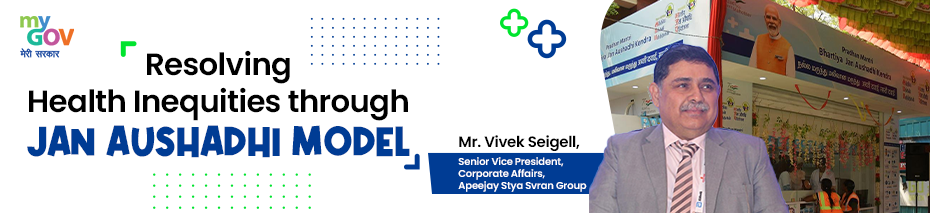
Resolving Health Inequities through Jan Aushadhi Model

India’s healthcare transformation journey has taken a landmark turn through the Pradhan Mantri Bhartiya Janaushadhi Pariyojana (PMBJP) — a flagship scheme that seeks to ensure access to affordable medicines for all, especially for the vulnerable and economically weaker sections of society. The initiative, steered by the Department of Pharmaceuticals under the Ministry of Chemicals and Fertilizers, has not only emerged as a model of accessible and quality healthcare within India but has now begun to attract attention from the global health community.
The programme, initially launched in 2008 and significantly restructured in 2015-16, aims to reduce the burden of Out-of-Pocket (OOP) healthcare expenditure by making high-quality generic medicines available through an extensive network of Pradhan Mantri Jan Aushadhi Kendras (PMJAKs). These Kendras now span the length and breadth of the country with 16000 plus outlets, offering over 2,100 drugs and 300 surgical items at highly affordable prices—without compromising on quality.
Generic medicines available at these Kendras are manufactured in WHO-GMP-compliant facilities and are quality-assured by NABL-accredited laboratories. In addition to essential drugs, the Kendras offer an expanded catalogue that includes nutraceuticals, glucometers, oximeters, and menstrual health products such as the Janaushadhi Suvidha sanitary napkins — ensuring holistic health access for women and families in every part of the country.
These Kendras are also fostering entrepreneurship and creating local employment, as they are operated by doctors, pharmacists, NGOs, and self-help groups with government support of up to ₹2.5 lakh. With the Ministry of Railways providing in-principle approval for Jan Aushadhi outlets at railway stations, the scheme is growing into a decentralized public pharmacy model that India and the world can learn from.
The real impact, however, lies in the savings and societal benefit. PMBJP has led to an estimated cost saving of more than ₹30,000 crore for Indian citizens — a staggering figure that highlights how strategic health affordability can be achieved at scale.
This vision for inclusive, affordable healthcare was powerfully echoed on a global stage. At the 78th World Health Assembly in Geneva — during the adoption of the World Pandemic Treaty — Hon’ble Prime Minister Shri Narendra Modi highlighted the Jan Aushadhi Kendras as a case study in public health inclusion.
Addressing the assembly, he noted:
“The future of a healthy world depends on inclusion, and the health of the world depends on how well we care for the most vulnerable, especially in the Global South who are particularly impacted by health challenges.”
The Hon’ble PM’s recognition of the Jan Aushadhi initiative at the WHO platform underscores the scheme’s relevance not only for India but for nations across the Global South that are striving to deliver cost-effective healthcare amid growing health insecurities.
Having been associated with this programme during its critical relaunch phase in 2015, my role at a leading Chamber of Commerce in the healthcare domain gave me the opportunity to contribute to the blueprint, policy framing, and early field implementation. The path was not without challenges — from dispelling myths about generic drugs among doctors, to ensuring supply chain reliability and building credibility in a competitive market. But the results we see today speak to the potential of collective will and vision.
In a world where equitable health access remains a pressing goal, Jan Aushadhi Kendras are emblematic of how strong public policy and innovation can intersect to serve humanity. As India continues to scale this model, it also presents a framework worth emulating for countries aiming to ensure health for all — not just as an aspiration, but as a deliverable reality.
Writer : Mr. Vivek Seigell, Senior Vice President, Corporate Affairs, Apeejay Stya Svran Group